
(Courtesy/Mr. Fish & Mr. DeVore)
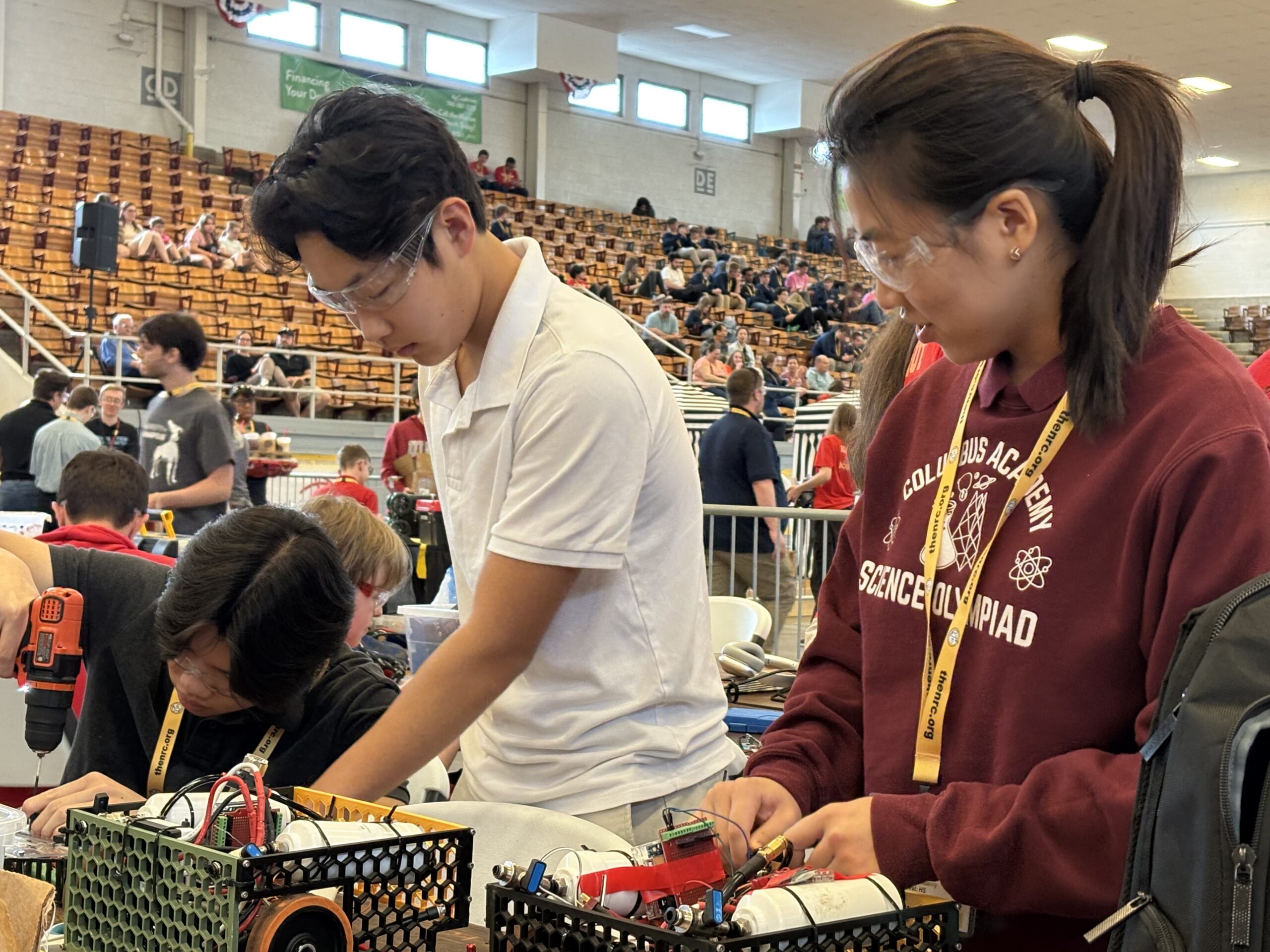
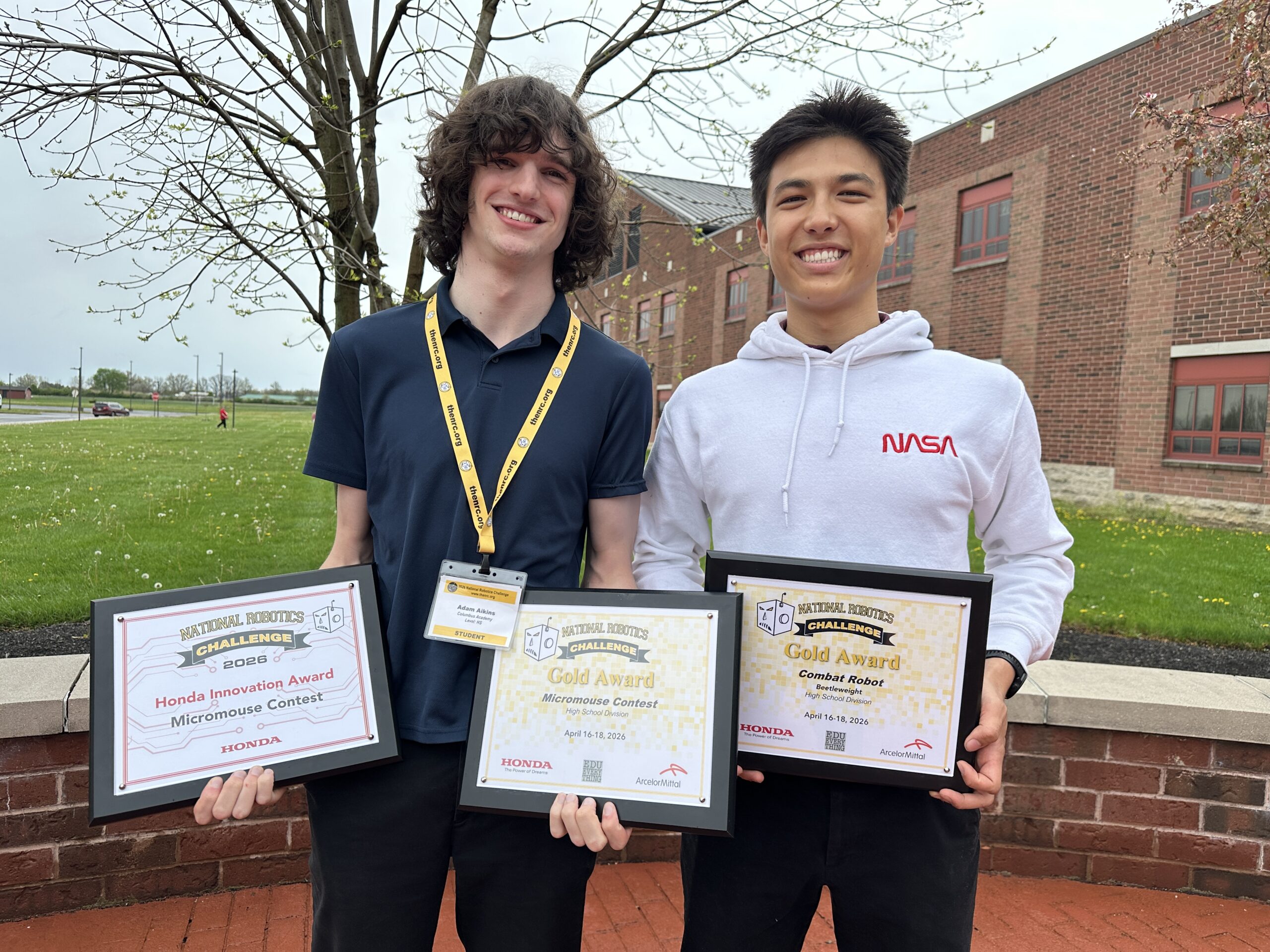
Academy’s Robotics team whirred to life on Thursday, April 16, for three days of competition at the National Robotics Challenge (NRC) in Marion. Over the course of the school year, students have dedicated hours outside of class designing, testing, and building robots ranging from nimble autonomous maze solvers to deadly combat fighters. This year’s competition was one of the best in Academy’s Robotics Club history, featuring multiple finalists, two gold awards, and the Honda Innovation Award for the third year in a row.
Founded in 1986 by the Society of Manufacturing Engineers (SME), the competition moved to Marion in 2003 and has since grown into the largest open-platform robotics event in the world. In its 40th year, it has expanded to include over 480 robots and more than 1,200 participants.
Our first day of competition featured the robohockey teams of Luke P. and Ryan Z. (Captain), and William D., Bella L., Landen L., and Jude S. (Captain). Robohockey features two robots per team competing to score the most goals in a three-minute match.
Ryan’s team, using 3D-printed parts and a belt-driven vertical shooting mechanism, lost two matches and fell out of finals contention. Jude’s team cleared their first opponent but lost their second match in a 0-1 overtime shootout after a loose valve leaked air from their pneumatic shooting system. In the loser’s bracket and facing elimination, Bella and Jude clinched a clutch win, qualifying them for finals on Saturday, the 18th, and securing the top-8 finish.
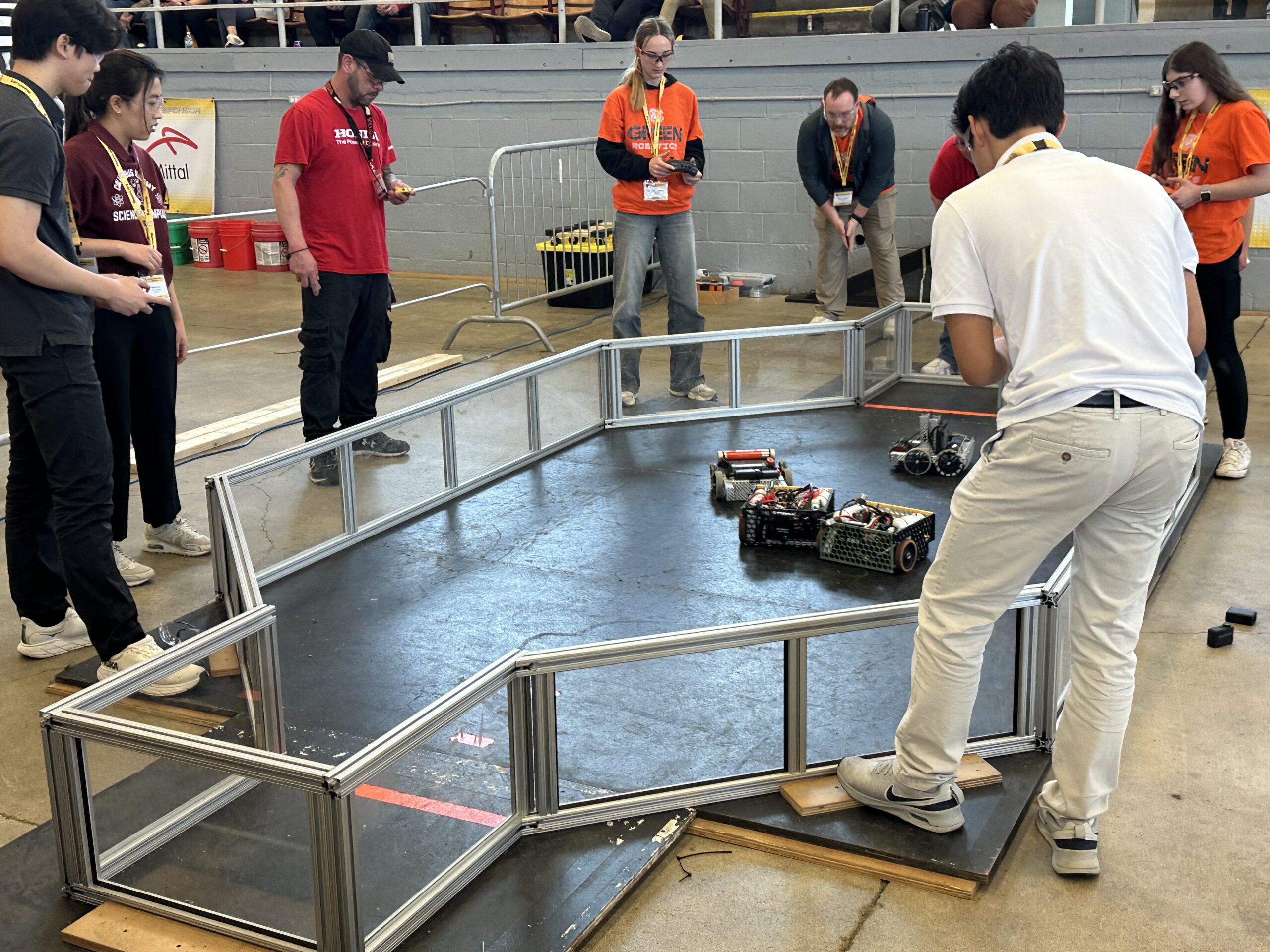
April 17 was mechanical chaos as the Combat Robot preliminary rounds and the Micromouse competition took place. As Academy’s most popular event with five entries, Combat Robot requires teams to build a unique machine that, as the NRC handbook states, “employs one or more methods of destroying or disabling their robot competitor,” all within a three-pound weight limit. Equipped with solid steel vertical blades, vicious parallel bars with metal teeth, or a simple titanium ramp, these bots can deal damage. Luke K. and Ishaan V. (Captain) used a classic ramp design built with sturdy HDPE and a titanium ramp, and outmaneuvered their first opponent to victory but fell short afterwards and lost in the loser’s bracket.
William (Captain), Bella, Landen, and Jude’s team suffered bad luck in the repair pit. Drilling holes for repair, they nicked their lithium battery, causing thick smoke and a fire that melted the robot’s interior, leaving a carcinogenic shell unsafe to use and ending their run.
Adam A. (Captain) designed a box-shaped robot with symmetrical titanium ramps and four-wheel direct drive, greatly improving the bot’s maneuverability. Ironically, Adam drove into the open hole in both of his losing matches and failed to qualify for finals.
Luke and Ryan (Captain) advanced to finals with a pair of easy first matches. The returning silver award winner, Dane (Captain), was back to win it all this year as his sleek, low-to-the-ground design and lethal beater bar decimated the prelims competition.
In contrast, the external shed housed the more peaceful Micromouse competition, where contestants designed compact autonomous robots to navigate a maze in the shortest time. Rohan N. (Captain) and Max B. (Captain) attempted to tackle this complex coding and engineering problem, but their robots didn’t complete the maze.
On the other hand, Adam’s mouse destroyed the competition and took home the gold despite a 30-second penalty. Not only was Adam’s mouse fully autonomous, but also his build process. In response to his achievement and secrecy, Mr. DeVore said, “I didn’t really know what he was building either . . . but it was truly amazing.” Judges noticed Adam’s engineering prowess, using spring suspension and a complex “flood fill” algorithm, and nominated him for the Honda Innovation Award – Academy’s third consecutive year nominated for the award in Micromouse.
Also on Saturday, two Academy teams traveled to Marion for the finals session: William, Bella, and Jude in Robohockey, also representing Ryan’s team for Combat Robot in place of their absences due to the Science Olympiad State competition taking place on the same day, and Dane in Combat Robot.
In Robohockey, Jude’s squad lost a controversial first match putting them in the losers’ bracket with a long road ahead. Robots are not allowed to enclose more than 50% of the puck. Yet multiple teams, including their opponent, violated the rule without penalty. Regarding the controversy, Jude, also the defending silver award winner, said, “It’s really bad how [the judges] can’t enforce their own rules. There’s only so much you can do against cheaters.” William and Jude survived in the loser’s bracket for another match, clinching a 3-0 victory, yet losing in the next round. Overall, Jude’s Robohockey placed 5th out of 17 teams.
In Combat Robot, Jude piloted Ryan’s crumbling robot to a quick first-match victory. The second match didn’t go as well, as the opponent’s powerful bar blew a hole into the side of Ryan’s bot, launching the electronics and battery into the open and forcing Jude to surrender. In the pit, William and Bella repaired the bot without spare parts, reviving the dubbed “Franken-robot” for another match. During the match, Jude landed a massive hit on the opposing robot. But the reaction pair resulting from the strike also decoupled Franken-robot’s weapon belt from the motor, and the judges ruled in favor of the opponent because their weapon still worked, resulting in a 5th-place finish.
Dane cruised to the championship match with two decisive knockouts. In the final, he repeatedly pinned his opponent against the wall, controlling the pace while landing heavy hits that shredded the chassis. His dominant performance secured Academy’s second gold award.
The 2026 National Robotics Challenge proved a success for Academy’s robotics team: three days of competition resulted in a three-peat in Innovation Awards and two gold medals. Mr. DeVore said, “I was really impressed with the designs we had this year. Even though not everything went to plan, and there were some robots I thought deserved better, I’m still proud of what [the team] has accomplished.”
Robotics is an iterative and continuous process. Mistakes are made, designs are scrapped, and models are refined and improved. CA Robotics will be back next year, ready to refine, rebuild, and push the limits even further.