

Izu N./Staff
Every day we walk through our hallways carrying textbook and supply-filled backpacks, a normal part of school life, which made me wonder how these heavy loads might affect our health.
To better understand how heavy students’ backpacks are during a typical school day, I conducted a two-day survey of 162 of our high school students from January 15-16.
During passing and free periods and before and after school, I asked students if I could weigh their bags using a handheld suitcase scale and record their grades and genders.
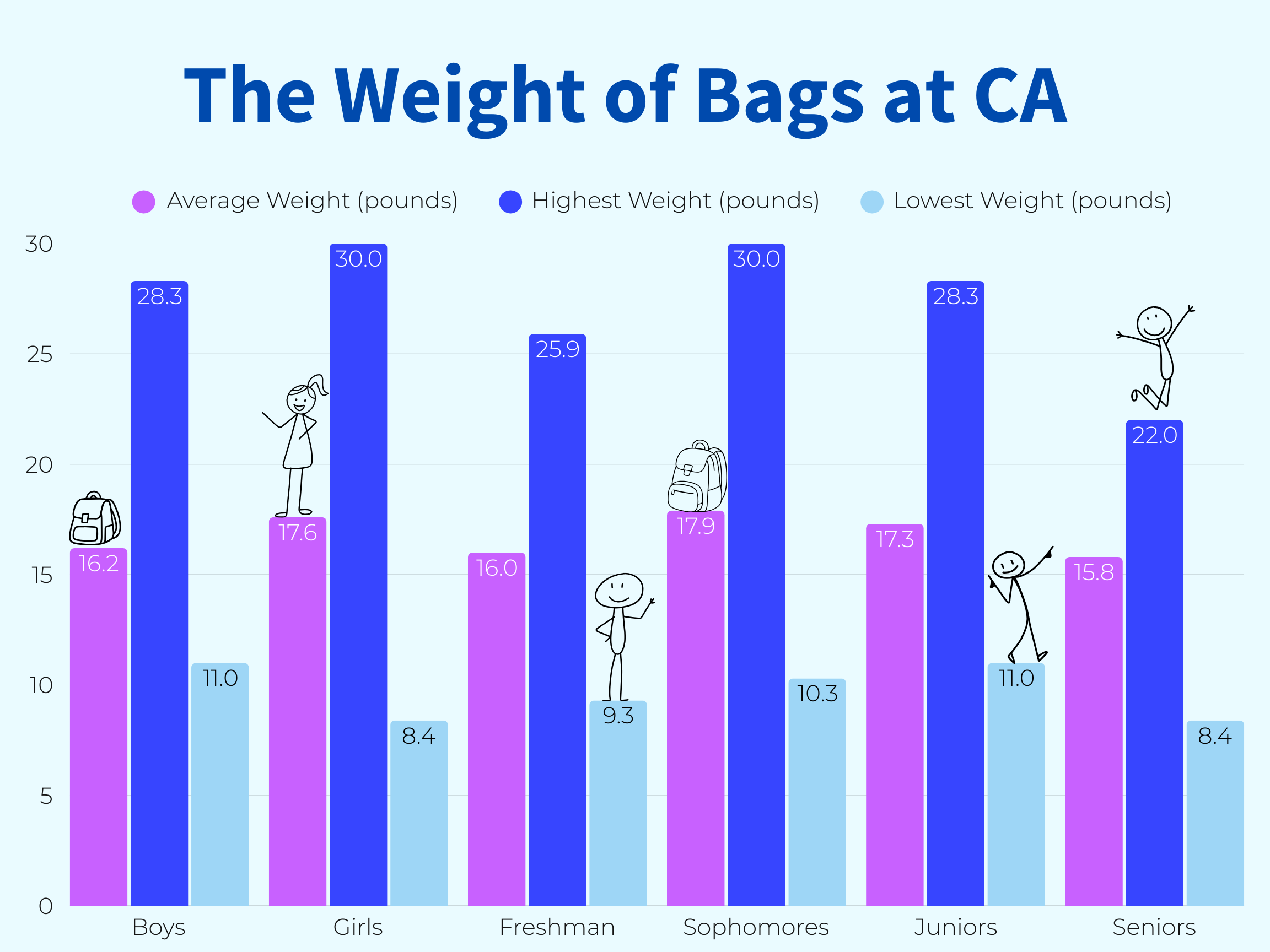
The results showed that the average backpack weight for boys was 16.2 pounds, while girls carried slightly heavier bags at an average of 17.6 pounds. By grade level, sophomores carried the heaviest average backpacks at 17.9 pounds, followed by juniors at 17.3 pounds. Freshmen averaged 16.0 pounds, and seniors had the lightest backpacks, averaging 15.8 pounds.
The heaviest backpack was 30 pounds for a female sophomore, while the heaviest for a boy was 28.3 pounds for a junior male.
In contrast, the lightest backpack weighed just 8.4 pounds and belonged to a senior. Several other students carried backpacks weighing close to or under 10 pounds, showing a wide range in what students bring to school each day.
According to the American Chiropractic Association (ACA), backpacks should generally weigh no more than 10 to 15 percent of a child’s body weight to prevent injury. For context, the average high school boy weighs between 100 and 152 pounds, which means a safe backpack weight would be about 14 to 21 pounds. For girls, who typically weigh between 101 and 140 pounds, the recommended limit is around 12 to 19 pounds. Based on these guidelines, many of the backpacks weighed at the school were close to the upper limit, and some exceeded it by a large margin.
“The problem is kids will come down and ask us for ibuprofen or something, and they don’t always tell us,” said Nurse Beckie Hoagland.
Nurse Janet Fireman says bag-related pain may be more common than it seems. She estimates that around 2 percent of students come in with noticeable back, shoulder, or neck pain. Fireman has also noticed an increase in complaints. “In the last four years, since Covid,” she said, “They seem heavier than they ever were. I don’t know if it’s because every kid feels like they have to take every book with them all the time. I think it’s insane.” When asked if students usually realize their backpack might be contributing to their pain, Fireman said, “I don’t think they realize that.” She recommends that backpacks should weigh no more than 10 percent of a student’s body weight.
Carrying a backpack that is too heavy over a long period of time can lead to more serious problems in the future. ACA warns that excessive backpack weight can cause chronic back, neck, and shoulder pain that may continue into adulthood. It can also affect posture, causing students to hunch forward or lean to one side, which places extra stress on the spine as it is still developing during the teenage years.
Over time, poor posture and repeated strain can lead to muscle imbalances, nerve compression, and increased risk of spinal issues such as disc problems. Some studies show that students who regularly carry overly heavy backpacks are more likely to experience long-term musculoskeletal discomfort, even after they stop carrying these heavy bags. These issues may not appear immediately, but they can develop gradually as stress is placed on the body day after day.
There are simple ways students can reduce backpack strain, such as carrying only what they need for the day, using lockers when possible, wearing both shoulder straps, and placing heavier items closer to their back. Schools can also help by encouraging the use of digital textbooks or coordinating assignments to limit how many materials students need to bring to school each day.
While backpacks may seem like a small part of daily school life, the data shows that they can have a real impact on students’ health, both now and in the future. Paying attention to backpack weight and making small changes could help prevent long-term problems and keep students healthier throughout high school and their lives.